

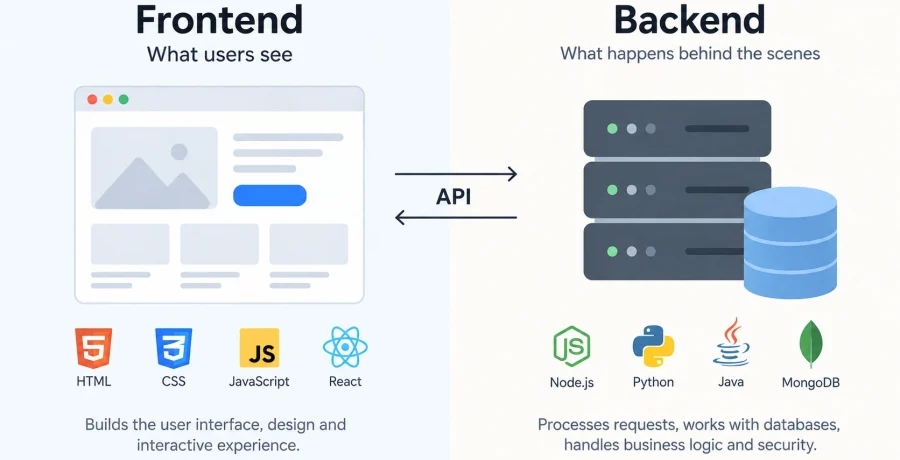
Frontend and backend development represent two different sides of building modern websites and applications. Frontend developers focus primarily on the interface people see and interact with, while backend developers build the systems that process requests, store information, enforce business rules, and connect services behind the scenes. For beginners, understanding the responsibilities, technologies, and everyday tasks of both paths makes it easier to decide which direction to study first.
What frontend development actually involves
Frontend development is responsible for turning designs, content, and application functionality into an interactive interface that runs primarily inside the user’s browser.
Everything visitors directly interact with on a website belongs largely to the frontend: navigation menus, buttons, forms, product cards, dashboards, animations, search interfaces, and responsive page layouts.
A frontend developer takes a visual design and translates it into working code. This requires more than making a page look attractive. The interface must work correctly across different screen sizes, respond to user actions, display data received from APIs, and remain accessible and reasonably fast.
Modern frontend development can range from building a simple informational website with HTML and CSS to creating complex browser applications containing hundreds of interactive components.
What backend development actually involves
Backend development focuses on the server-side systems that receive requests, process information, communicate with databases, and return results to applications.
Consider an online store. The frontend can display a login form, but the backend verifies the credentials. The frontend can show an “Add to Cart” button, while the backend may store the cart, check product availability, calculate prices, create an order, and communicate with a payment provider.
Backend developers therefore work extensively with servers, APIs, databases, authentication, business logic, security, caching, and integrations with external systems.
Much of this work is invisible to users. A customer may only see a confirmation message after placing an order, even though numerous server-side operations happened in the background.
The main differences between frontend and backend development
Frontend and backend developers contribute to the same product but solve different categories of technical problems.
- Area of responsibility. Frontend development concentrates on what users see and interact with, while backend development manages data, server-side logic, APIs, authentication, and infrastructure-related functionality.
- Execution environment. Frontend code commonly executes in a web browser, whereas backend code generally runs on servers or cloud infrastructure.
- Visual work. Frontend developers regularly work with layouts, typography, responsive interfaces, animations, and design systems. Backend work is usually less visual.
- Data handling. Backend developers frequently design database structures, validate information, control permissions, and implement rules governing how data can be created or changed.
- Testing priorities. Frontend testing often focuses on interfaces and browser behavior, while backend testing concentrates more heavily on APIs, business logic, databases, reliability, and security.
Despite these differences, frontend and backend systems constantly communicate. A frontend application might send an API request asking for a user’s profile, and the backend retrieves the appropriate information and sends a response that the frontend displays.
Which technologies frontend developers typically use
Frontend development begins with the core technologies of the web and can later expand into frameworks, build tools, testing systems, and specialized libraries.
- HTML. HTML defines the semantic structure of web pages, including headings, paragraphs, images, links, forms, tables, and other elements.
- CSS. CSS controls presentation, including colors, typography, spacing, layouts, responsive behavior, transitions, and animations.
- JavaScript. JavaScript adds programming logic and interactivity, allowing interfaces to react to user actions, communicate with APIs, and update content dynamically.
- Frontend frameworks. Technologies such as React, Vue, and Angular provide structured approaches for developing larger interactive applications.
Frontend developers may also work with TypeScript, package managers, Git, browser developer tools, testing frameworks, design systems, and build tools.
Beginners should generally understand HTML, CSS, and JavaScript fundamentals before depending heavily on frameworks. Frameworks change over time, while the underlying principles of the web remain important across different technology stacks.
Which technologies backend developers typically use
Backend development offers a wider choice of programming languages because many different technologies can perform server-side processing effectively.
- Server-side languages and frameworks. JavaScript with Node.js, Python, PHP, Java, C#, Go, and other languages can be used to create backend applications and APIs.
- Databases. PostgreSQL, MySQL, SQLite, MongoDB, and other database systems store and organize application information.
- APIs. Backend developers create interfaces through which frontend applications and other services can request information or trigger operations.
- Infrastructure tools. Git, containers, cloud services, web servers, caching systems, monitoring tools, and CI/CD platforms often become part of backend workflows.
A beginner does not need to learn all of these technologies simultaneously. One programming language, one web framework, SQL, a relational database, Git, and basic HTTP concepts provide enough material for building meaningful beginner projects.
Understanding how these components interact is more valuable initially than collecting experience with many different frameworks.
What skills and personality traits fit each development path
The better direction often depends less on whether one field is easier and more on which types of problems a person enjoys solving repeatedly.
Frontend development may appeal to people who enjoy combining technical problem-solving with visual results. Changes can often be seen immediately in the browser, and developers frequently think about usability, layouts, accessibility, responsiveness, and how users interact with an interface.
Backend development may appeal more to people who enjoy logic, data structures, system behavior, APIs, databases, automation, and solving problems that do not necessarily have a visual result.
However, these are tendencies rather than strict personality requirements. Frontend applications can contain highly complex programming logic, while backend development can require significant creativity in designing simple solutions to complicated business problems.
Both directions require patience, debugging skills, attention to detail, continuous learning, and the ability to break large problems into smaller tasks.
How a beginner can decide between frontend and backend
The most reliable way to choose a development direction is to experiment with both sides through small practical projects rather than making the decision entirely from descriptions.
- Learn basic HTML and CSS. Create several simple pages and determine whether building and refining interfaces feels interesting.
- Learn programming fundamentals. Use JavaScript, Python, or another beginner-friendly language to understand variables, conditions, loops, functions, objects, and asynchronous operations.
- Build a small frontend project. Create an interactive page that receives information from a public API and displays it to the user.
- Build a simple backend. Create an API that accepts requests, processes information, and stores several records in a database.
- Compare the experience. Consider which problems you enjoyed solving, not simply which project initially felt easier.
This approach gives beginners direct experience with both disciplines while teaching how the two parts communicate.
Should beginners learn both frontend and backend
Beginners can benefit from understanding both sides of web development without trying to become equally advanced in every technology at the same time.
A frontend developer who understands servers, HTTP, APIs, authentication, and databases can communicate more effectively with backend developers and diagnose integration problems more easily.
Likewise, a backend developer benefits from understanding how browsers and frontend applications consume APIs. This knowledge can influence decisions about response formats, authentication mechanisms, validation, pagination, errors, and performance.
Learning both sides also makes it possible to create complete personal projects. A beginner can build an interface, develop an API, connect a database, and deploy the resulting application.
However, attempting to master every frontend and backend technology simultaneously can slow progress. It is often more practical to establish broad fundamentals and then specialize more deeply in one direction.
Which path should you start with as a beginner developer
There is no universal starting path: frontend is a natural choice for beginners interested in interfaces and visible results, while backend is suitable for those more interested in programming logic, data, and server-side systems.
Frontend can provide a relatively accessible introduction because a beginner can create a basic HTML page and immediately see the result in a browser. CSS introduces visual design and responsive layouts, while JavaScript gradually adds programming concepts and interactivity.
Backend can also be an effective starting point, particularly for someone more interested in how applications work internally. A beginner might start with Python or JavaScript, learn programming fundamentals, then progress to HTTP, APIs, SQL, databases, and server-side frameworks.
Whichever path you choose, avoid treating the decision as permanent. Frontend and backend are closely connected disciplines, and developers frequently expand their knowledge over time. The most useful first direction is the one that keeps you building real projects, solving increasingly difficult problems, and developing strong programming fundamentals that can later be transferred to other areas of software development.